Saturday, September 5, 2015

Ideology in my Controversy

In this post I will dive deep into the debate regarding artificial intelligence or AI. I will be explaining what kinds of people are taking which sides, why they're taking these sides, what values these groups have, and many other aspects of this controversy. 

By in large, the two clashing parties in the debate regarding AI are those researching and developing AI and those who are not. There are several exceptions, with several notable AI developers warning of the potential danger in AI. However, most of those opposing AI development have no involvement or association with its development and are terrified of the potential dangers AI pose.

Olivarez, Jennifer, "MEAP the Robot from Squirrle picnic.com", 2/25/2015 via Flickr, Attribution-NonCommercial-ShareAlike 2.0 Generic License
A major speaker against the development of AI is Stephen Hawking. Hawking has expressed concern about the future of AI and its potential consequences against mankind. A major speaker for the development of AI is Sabine Hauert. Hauert is a big proponent of AI development and is very vocal about its benefits. Hauert encourages all other scientists developing AI to speak up and explain all of the potential benefits AI could have.

Those in favor of AI development typically hold a slightly higher social/economic/political status as opposed to those opposed to AI development. This is simply because many of those working on AI development are top scientists, and are therefore making more money and commanding larger political influence. 

The main resource those opposing AI development has over those in favor is the media. The majority of blogs, articles, and stories on the subject of advanced AI spread fear of robots taking all of our jobs away. There is also the fear of a dystopian society where robots rule the world. Because of this stigma for AI, many developers of AI avoid the media all together, and don't put out content explaining their work. This causes an imbalance in the media, leading more and more people to fear AI development.

Each group essentially values the same thing, our society's overall well-being. However, the two parties have different ideas of how to protect their value. 

There also lies a problem in the power differential between the groups. While those opposed to AI development largely control popular media, those in favor have more money and influence. 
Linden, Torley, "CLOSE UP ROBOT FACE", 6/17/2008 via Flickr, Attribution-ShareAlike 2.0 Generic License

Each group acknowledges that if handled poorly, AI could spiral out of control. However, those in favor of AI believe it can be avoided as long as we are smart about it. Those opposing AI don't hold this same belief. Both groups acknowledge they just want the best for mankind.

I believe an unacknowledged common ground is that both parties want to have jobs. These scientists developing AI don't want to replace themselves with machines. And those opposed to AI development don't want to be replaced either. 

These groups do listen to what one another has to say. I've seen several articles where compromises have been proposed in order to both develop our AI technology, yet ensure our own security. Also, a large majority of AI developers go to great lengths to ensure their own technology doesn't get the best of them.


Evaluation of Social Media Sources

In this post I will be evaluating two social media sources regarding artificial intelligence.

The first source was posted on The Washington Post on July 7, 2015. The blog post, titled "The very best ideas for preventing artificial intelligence from wrecking the planet" and authored by Dominic Basulto contains five different ideas to prevent artificial intelligence from causing significant harm to mankind.

Screenshot from my computer, 9/5/2015
The author, Dominic Basulto, is far from an expert on the topic of artificial intelligence. Basulto is a blogger for The Washington Post and Big Think. Basulto also writes travel guides available on iPad and Kindle. Basulto is not directly in any events regarding artificial intelligence. Basulto's network consists of other bloggers and journalists.

The information can be verified by other sources linked by Basulto. Basulto has written several blogs on the topic of artificial intelligence. One other past post explained why Basulto believed the world's most intelligent people don't have to worry about artificial intelligence. 

Basulto has been with The Washington Post for four years, granting him more credibility than someone with significantly less time invested into their accounts. Basulto's post is somewhat reliable. While Basulto himself is no expert of artificial intelligence, some of his sources come from experts.


The second source I chose was published on nakesecurity.com on July 24, 2015. The blog post is titled "Artificial Intelligence expert likens AI dangers to nuclear weapons". The author, Mark Stockley, is an independent web consultant. Stockley belongs to no organization or institution that bestows him with special credibility. Stockley is not necessarily in position to give his own input about the matter. There doesn't appear to be anyone in Stockley's network tied to the topic of artificial intelligence.

While Stockley himself may not be an expert on artificial intelligence, his sources are. Stockley bases much of his article on the ideas of Stuart Russell, an award-winning researcher in the field of artificial intelligence. Coincidentally, Stuart Russell collaborated with a few other artificial intelligence experts in a scholarly article I reported on in my Evaluation of Scholarly Sources post.

Stockley's nakedsecurity account is six years old, granting him slightly more credibility than someone whose account is new. Stockley does not regularly post about the topic of artificial intelligtence.

Overall, Stockley's post is somewhat reliable. With no personal expertise in the subject matter, it is difficult to grant his work undeniable credibility. 

Evaluation of Scholarly Sources

In this blog post I will evaluate two scholarly sources regarding artificial intelligence. 

In Khashayar Behdinan's paper titled "Using Artificial Intelligence to Aid Measurement Accuracy and Reliability in Coriolis Gas Flow Meters", Behdinan explains the implications of artificial intelligence or "fuzzy logic" in measuring gas flow.

Screenshot from my computer, 9/5/2015


The purpose of this paper was to explain the implications of artificial intelligence in measuring gas flow. Behdinan spent much of the paper explaining how fuzzy logic specifically will revolutionize gas flow technology. 

This paper was published electronically in Instrumentation Symposium 2014, IET & ISA 60th International online journal. Behdinan mainly cites books regarding oil flow measurement. 

Behdinan's intended audience is those interested or invested in Coriolis gas flow. I found the paper by searching for IEEE Xplore digital library for the keywords "artificial intelligence". 


The online article titled, "Robotics: Ethics of artificial intelligence", compiled by Stuart Russell, Sabine Hauert, and Russ Altman explores various aspects of the debate regarding artificial intelligence. 
Screenshot from my computer, 9/5/2015

The purpose of this article is to promote awareness about different aspects of artificial intelligence. The article is broken up into four specific sections. Each sections specific subject is written by an expert of that subject. 

The article was published electronically in an international weekly journal of science called Nature. Specifically in volume 521, published on May 27, 2015. The article mostly cites previous editions of the same journal.

The intended audience is those concerned with or interested in artificial intelligence. I found the article by searching "artificial intelligence" on Academic Search Complete.


Evaluation of General Sources

In this blog post I will evaluate two sources on the subject of artificial intelligence. I will base my evaluation on seven different aspects of each source.

In the article, "Artificial Intelligence: Hawking's fears stir debate", a debate on the dangers of artificial intelligence is examined.
Screenshot from my computer, 9/5/2015

URL

The URL of this post indicates a significant amount of credibility. The post is on phys.org. Based on the URL, this post is reliable.

Author

The authors of this page are Richard Ingham and Pascale Mollard. I tried looking up both of these authors, but could only find other articles they wrote on phys.org. Since I could not find their names else where, it leads me to believe these might not be the most credible authors.

Last Updated

It appears that the article has never been updated. I would not say this entirely discredits the article, but it does hurt the credibility. The field of artificial intelligence is constantly evolving, and authors should be updating their posts with the most recent information available.

Purpose

The purpose of this article was to inform readers on the debate regarding artificial intelligence. This purpose does not give too much information on the reliability of the article.

Graphics

There are several relevant images in the article, including several pictures of machines based on artificial intelligence. The images enhance the article and add to its credibility.

Position on Subject

The authors take a neutral stance on the subject matter and do their best to report both sides of the argument.

Links

There are several links that enhance this article. One links the reader to "Explore further", which leads to another article on the state of artificial intelligence.


The other article I read, "Up for Debate: Is Artificial Intelligence a Threat to Humanity?", is also about the debate on artificial intelligence.
Screenshot from my computer, 9/5/2015

URL

The URL ending .edu adds credibility to the information in the article, as opposed to a .com ending which would not add credibility.

Author

The author, Katy Bowman, is the Marketing and Communications Writer for John Hopkins Center for Talented Youth. She is no expert on the subject matter, but she does gain credibility from her years of experience in journalism.

Last Updated

The page does not appear to have been updated at all, which takes from the articles credibility.

Purpose

Bowman's purpose is to inform her readers. She does not appear to take a side on the matter,which is a good choice considering this is not her realm of expertise.

Graphics

The post only has one graphic, which is not even captioned. This hurts the strength of the article.

Position on Subject

Bowman does not appear to take a position on the subject, and is merely reporting her findings on the subject matter.

Links

Bowman includes several links to relevant subject matters such as a link to a book published on the dangers of artificial intelligence.

Friday, September 4, 2015

My Field of Study

Of the seemingly infinite fields of study, computer science is the field I've chosen to study. In this post, I'll elaborate on what computer science is, what kinds of jobs exist in the field, why I chose computer science, who the leaders in the field are, and what the leading scholarly journals are in the field.

Within the computer science major, students learn to program algorithmic processes that have large scale implications in using computers and a wide variety of other technology. Students also learn about the actual theory behind programming and developing computational systems.

 In other words, we learn how to make computers do things for us.

wiredforlego, "LEGO Collectible Minifigures Series 7 : Computer Programmer", 4/19/2012 via Flickr, Attribution-ShareAlike2.0 Generic License


After earning a degree in computer science, there are a myriad of careers a computer science major typically go into.

Many go on to become computer programmers at all different kinds of companies. Others will work on developing actual computer parts that will change the way computers work all together. Some will develop their own software to sell over the internet. Nearly all the career paths computer scientists take will involve some elements of software or hardware development.

In such a broad field, countless computer scientists are pushing the boundaries of what computers can do. A group of five scholars known as the Siebel scholars are each pursuing a unique and intriguing aspect in computer science.

Thiago Pereira, one of the Siebal scholars, is focused  on designing the mechanics to optimize 3D printing. He is currently testing various uses of light reflection and scattering on surfaces to improve our current 3D printing techniques.

Another Siebal scholar, Omri Weinstein, is focused on researching interactive communication in relation to security and economics. Weinstein's work led to a breakthrough in several areas of communication, specifically in parallel computation and secure multiparty computation.

Of course, with such an enormous field of study, there must be central outlets used to communicate the most recent research and findings.

IBM Journal of Research and Development published on ieeexplore.ieee.org is one of the leading sources for up to date information on all aspects of computer science.

The IEEE Transactions on Information Theory is another journal published on  ieeexplore.ieee.org that focuses on papers concerning the transmission, processing, and use of information theory.

The online journal Computer Vision and Image Understanding published on www.elsevier.com focuses on original research papers regarding theory of algorithms and formal languages.

And that's a quick overview of my field of study.

EDIT:

After reading some of my classmates posts, specifically Laurence's and Chelsea's, I realized how important it is to find your professional passion. Both of these writers expressed great interest in their respective fields, and that inspired me to find exactly what I want to do within computer science. I also realized how closely related computer science is to many other fields. Both Laurence's interest in mechanical engineering and Chelsea's interest in Biosystems engineering will inevitably involve the use of computers and programmable technology. All of our fields have a connection to one another, as I may be the person programming their inventions in 20 years!


Saturday, August 29, 2015

My Thoughts on Comments

In the comments section of the Newsweek article on GamerGate, dozens of users logged on to leave comments on the subject matter. Many had intelligent thoughts and well written comments. Others did not.

Credible Comments:

#1

 I thought Brian's comment was credible for a number of reasons. Brian included several facts and even calculations on the subject matter. He used correct grammar and appropriate punctuation. I suppose one sketchy aspect of Brian is his so called "self-employment", but I will give him the benefit of the doubt on that one.

Brian seems to fear that the article and similar forms of media are giving people the wrong idea. We can tell by the way Brian strongly argues his opinion with statistics. Brian believes that the claims of harassment are dramatized and should not be seen as egregious. We can tell by some of things he says. For example, Brian states that a very low percentage, roughly .0004% of all GamerGate tweets contained true harassment.


#2
I believe Johnathon is credible for a few reasons. First of all, Johnathon draws on personal experiences of his in the gaming world to formulate his opinion. Also, Johnathon speaks with a very mature and intellectual tone using words such as "misogynistic" and "polarizing". 

It seems as though Johnathon fears people will believe there is no form of sexism in the gaming world at all. He explains at length his thoughts on sexism towards both men and women in the gaming industry, citing his own experiences with online gamers. Johnathon believes that neither men nor women are perfect in the gaming industry and that neither gender is innocent.

Uncredible Comments:

#1


Brine Cat lacks credibility for several rather obvious reasons. For starters, Brine Cat refuses to use correct grammar, spelling, and punctuation for the entirety of his comment. Also Brine Cat seems to express two different opinions. Initially he calls the harassment a form of criticism, but he then says that GamerGate is all about harassment. 

Brine Cat seems to fear the alienation of females in the gaming industry. He talks briefly on this and says GamerGate is aimed towards harassing these women. Brine Cat seems to value equality between men and women based on the way he defends the women being harassed at the end of his comment.

#2

Handre lacks credibility because of the way he writes his comment. Unnecessary use of curse words and capitalization makes Handre appear as someone who is ignorant and unstable.

Handre seems to fear that criticism can't be made against certain parties anymore. Handre calls the GamerGate tweets "legitimate criticism" and is upset at the way the media is portraying GamerGate. Handre seems to believe that we can say what we want as long as it is intelligent criticism. We see that in the first couple sentences of his comment.

EDIT:

 After reading Bri's and Samantha's posts on comments, my idea of credible comments is reinforced. Credible comments will be controlled and analytical. The writer will clearly be passionate about the subject, but they won't let their emotions dictate their post. They express their fears, but not in a way that shoves information and opinion down the reader's throats. Comments that lack credibility often allow anger and even hatred to dictate their posts. They make no attempt to hide their fears on the subject, which hurts the credibility of their writing.


My Controversy

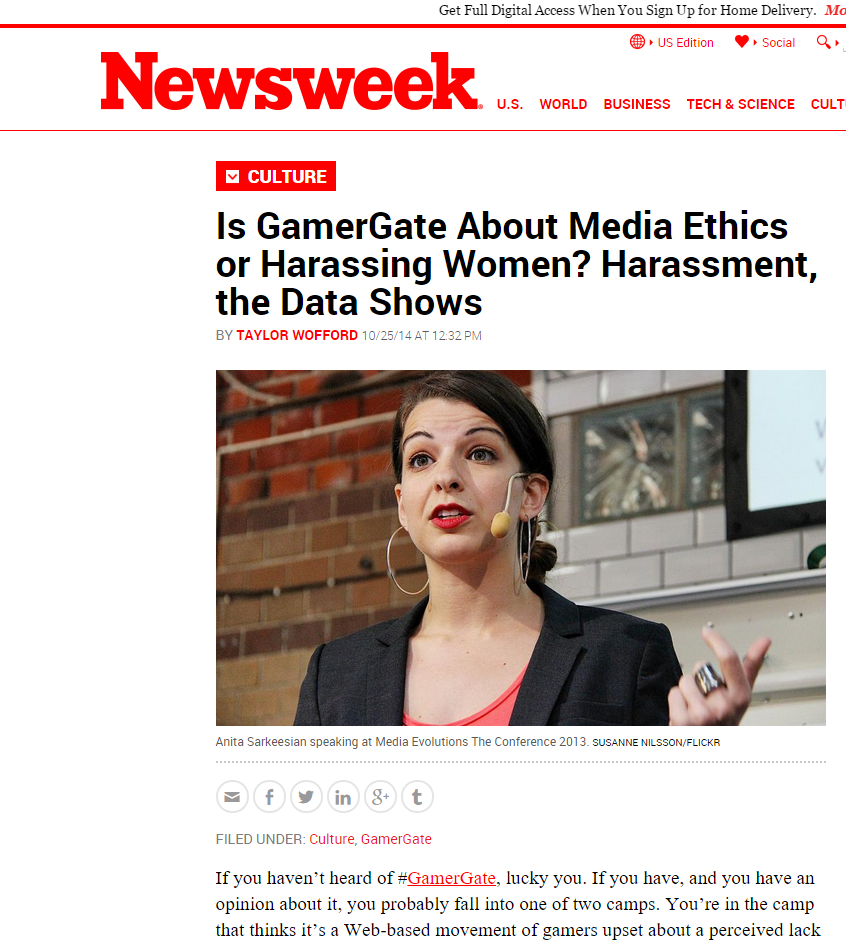
http://www.newsweek.com/gamergate-about-media-ethics-or-harassing-women-harassment-data-show-279736
On the website Newsweek, I found my controversy. The controversy, GamerGate, is relevant to me because I love to play video games and regularly consume gaming media.

Beginning in late 2014, harassment of female game developers became a trend on social media sites such as twitter. Those harassing prevalent female developers were calling the ethics in gaming journalism into question. Specifically in regards to a relationship between developer Zoe Quinn and gaming journalist Nathan Grayson. Many believe the review Grayson wrote regarding Quinn's work was biased due to their personal relationship. Others believe their relationship had no bearing in the review and that this incident was falsified to create an excuse to harass women in the gaming industry. Regardless, a large majority of the blame is being put on these female developers, while very few fingers are pointed at the actual journalists.